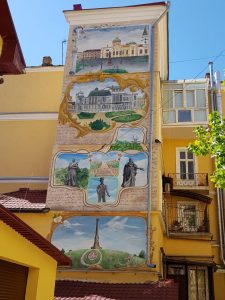
The story of a city that emerged from the ground, decreed by a Russian Tsarina, built by Italians and French, developing as an essential port on the Black Sea. A city that became a crossroad where Greeks, Russians, Poles, Turks and of course Jews would rub shoulders.
Odessa, a city far from the battle lines between Russians and Ukrainians, was the home of Babel’s The Odessa Tales, with its inhabitants speaking Greek, Turkish, Arabic, Italian, Yiddish and even Hebrew.
Many of the world’s most famous writers would spend time there, including Pushkin, Gogol, Hemingway, Simenon and Mark Twain.
This city, for a longtime the most cosmopolitan and the most exotic city of Ukraine, is famous for its Potemkin stairs, its Opera House, its elegant buildings but also its rich markets.
Third largest Jewish city in the world at the beginning of the twentieth century, this Ukrainian pearl was the adopted home of many of the founders of Zionism, from Ahad Haam to Jabotinsky and Dizengoff to Bialik. It was the cradle of the Chovevei Zion movement.
City of culture, Odessa, was often the port on the way to the Land of Israel. Many consider it an inspiration for the builders of Tel Aviv and the walls of some of its houses still remind us.
This journey is an invitation to discover the city, its stories, or rather its Jewish stories, and its place in the history of the founders of Zionism.
Picture: Sergei Utochkin, symbol of the city and its Jewish history. Sergei Utoshkin was a national hero, sports champion, the first to descend the famous Potemkin stairs by bike as well as by car. Recognized as Righteous Among the Nations, he opposed the mob about to start a pogrom in 1905.